 A Horse Path
A Horse Path
Shows and Horse Fairs
When the fastest way to travel was by horse, and the majority of movement of people and goods as well as much of what happened in fields and battlefields, relied upon horse power. There were millions of horses in England. Needless to say there were also many markets for horses. Horse Fairs would deal in work horses, carriage horses, fine ponies, 'soldiers' (horses for the army), some attracting buyers from far and wide in Europe such as to the great fair at Howden in Lincolnshire.
A few horse fairs persist in addition to those mentioned above, and they have very specific characters:
Devon
Widecombe Fair
Always the second Tuesday in September. Has nothing of the vigour of times past, but an old grey mare wanders through town and a country fair rides on the back of a song of which most of us somehow know a little. Some Dartmoor ponies for sale, other livestock, produce, craft demonstrations, country race from hill to fair, tugs o' war.You probably remember a few lines of the famous rhyme, but do you remember this bit ... ?
When the wind whistles cold on the moor of a night,
Tom Pearce's old mare doth appear ghastly (or is it ghostly) white.Dartmoor Drift
Read more on-line about the annual round-up.
Gloucestershire
Stow Fair
May and October sales - Thursdays nearest 12th May and 24th October based on the original charter days from 15th century. This travellers fair really begins on the Monday between Stow on the Wold and Maugesbury.
Lincolnshire
Brigg Fair
with a charter granted in 1204, Brigg has held a fair and then horse fair for nearly 8 centuries. It went into decline in the 1970's the travelling community was driven away when the right to sell horses was gained by a local auction company. One man kept the tradition alive, selling just two horses each year. By 1993 Brigg and District Community Association agreed to organise the event, travellers have been encouraged to return and in the year 2000 over 25,000 people came to the centre of the town to see 100 horses traded and enjoy a fun fair, craft stalls and traditional entertainments. The day usually opens with Tom Glossop singing Brigg Fair ( music by Delius based upon a gypsy song) and other Lincolnshire folk songs. There was no Brigg Fair in 2003 because of problems with finding a place to house the horses.
The date moved from 20 July St James' Day to August 5th with the change in the calendar in 1752.Read more on the BriggLife web-site.
London
Barnet Fair
4-6 September (unless one of those days is a Sunday) - nearly 800 years old, originally London cabbies bought their horses here, now they seek ponies for their children. Near Barnet Station and the Great North Road. Barnet races, costermongers joined the throng.The London Harness Horse Parade
on Easter Monday has removed from Regents Park back to its original venue of Battersea Park where it began in 1886 to improve the treatment of London's carthorses and encourage their careful use.NB - In 2006 it is being held on 17th April at the South of England Showground, West Sussex - always check details with the organisers before making travel arrangements (contact Corrie Brown, +44(0)1737 646132).
Somerset
Priddy Sheep Fair
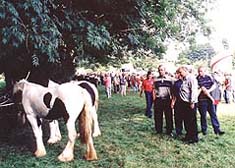
also a place to see horses, see the picture on the top right. The Wednesday before 21st August. Read more on-line.
Westmorland
Appleby Horse Fair
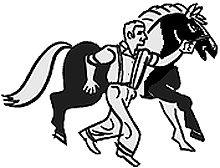
The second Wednesday in June is the day for dealing, and last day of the fair. Travellers arrive from the Thursday before and the main days for visitors are Saturday through to Wednesday) Appleby in Westmorland - charter James II since 1685, persists despite attempted closure 1965.Our greatest one day gathering of travellers which lasts at least a week! Every kind of vehicle, from the traditional vardo to the cut-glass caravan, camps on Gallows/Fair Hill. Horses are washed in the river Eden and run or ridden them through the town. All manner of dealing and socializing, entertaining and fortune telling, bargaining for glass and china, harness and saddles goes on through the day, ending with trotting races in the meadow. Many coloured ponies demonstrate their paces - black and white, brown and white - robust and showy they are used for drawing carts and loads, riding and selling as well as bringing pride to their owners. Illustrated top left by Ed Briant.
Yorkshire
Lee Gap
800 years old and counting. This fair at West Ardsley near Wakefield was once held for three weeks and three days around St Bartholomew, now it happens on just two days First and Latter Lee. Lee Gap Fair 24 August (St Bartholomews Day), Latter Lee 17 September. Other shows across England:
The Royal Show, Bath and West Show, all the regional and county agricultural shows such as Bakewell and Moorgreen have classes for horses of all kinds, some specifically to show the paces and beauty of the regional breeds.
Sources:
David Kerr Cameron The English Fair.
Charles Kightly Customs and Ceremonies of Britain.
And many web sites and telephone calls.
 THE 'OBBY 'OSS ...

