 Producing the Goods
Producing the Goods
Northumberland Tartan
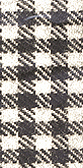
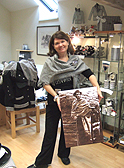

A love of local history prompted Catherine Wylde to start her own business in 2001 from a bedroom in her house. She had been interested in early references to the shepherd or border plaid (traditionally the official tartan of Northumberland) and thought she would develop it.
This black and white plaid has a long history. A fragment of the pattern, found on the Antonine Wall by workmen digging a trench, has been dated by archaeologists to the third century. The Romans called the pattern “scuttulata”, the same word for an owl’s breast with its light and dark markings.
Originally each measured up to 20 feet long, woven of black and white wool and waterproof (much of the lanolin was left in). Shepherds wore them wrapped around themselves until surprisingly recently. The most recent photograph Catherine has seen showing a man wearing one as a working garment was taken in 1960.
Catherine says that she feels “steeped” in Northumberland. “There are big skies and a rich heritage. The Northumbrians have been isolated for so long their character is proud and they have a great sense of humour. They have [more] time for you [than southern city people] and possess a strong identity.
She wanted to use a local mill, but regrettably Otterburn Mill nearby, although a popular visitor attraction. was not producing cloth. Instead she approached a mill nearby in the Borders. Cheviot wool traditionally used is now considered too coarse for our taste so a mix of breeds is used. “Ideally I would like to do all the weaving in Northumberland and use local wool, possibly from a herd of Jacob’s sheep I know about nearby. If I win the lottery, I’d like to buy Otterburn Mill and weave my plaid again there!”

Ten black and white scarves made up her first sale. “I thought people wouldn’t accept an English tartan so I have always put on a tag to explain the history”. She walked up and down outside Newcastle’s Tourist Information Centre trying to get up the nerve to ask the manageress if she would stock the scarves. “I am eternally grateful to her for taking all ten and they sold so quickly they ordered more. Although there is no connection with the plaid, Newcastle United football team wear black and white which I am sure helps sales in the city!”
Three years ago Catherine opened a shop within Kirkharle Courtyard, birthplace of Capability Brown. The converted group of attractive brown stone coach buildings also house, amongst others, a sculptor, a violinmaker, a wood turner and a soap maker.
Creating a market and building up customers for Northumberland tartan has been hard work. Catherine says, “People do want to buy locally with their hearts but are not always able to with their purses.” She employs people who live nearby to help make her product and pays them above average rate for their help. "It is difficult when you’re competing with cheaper imported goods, often of inferior quality – and I do feel that more should be done to promote local goods”. Especially poignant when the shop of a nearby stately home is entirely stocked with French reproduction bric-a-brac rather than locally sourced products.
Catherine's stylish shop is well stocked with a chequered mass of Northumberland tartan – from scarves for around £16 (which people buy as souvenirs) to full blown wedding outfits complete with Northumbrian kilts for up to £1,000. The black and white check is timelessly elegant and she combines it with sharp slashes of bright colour.
Catherine is still so passionate about the history of the plaid in Northumberland that in her spare time she gives lectures on it.
Leana Pooley for Common Ground, 2007
Contact: The Northumberland Tartan Company
Kirkharle Courtyard, Northumberland
+44(0)1830 540 435
<www.northumberlandtartan.co.uk>

