 Producing the Goods
Producing the Goods
Whitby Jet

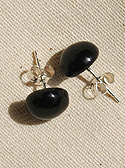
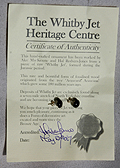
According to Hal Redvers-Jones of the Whitby Jet Heritage Centre, jet was mined extensively in the 19th century within a seven mile radius of the town. The layers of jet date back to 180 millions ago when the British Isles was still joined to Northern Spain, and is formed from fossilised monkey puzzle trees. Whitby’s jet is of very pure quality and hard. If a diamond rates as the hardest stone at 10 then jet would be nearly 4.
Jet is no longer mined but is found by natural coastal erosion. A storm of gales will cause damage to the cliffs and could uncover a seam of jet. Redvers-Jones says “If I hear there’s to be a 4.7 north easterly wind with a big tide, I’ll be rubbing my hands with glee at the possibility of someone bringing in some jet”.
In the 1860s there were 200 jet workshops and out of a population of 4,000, an incredible number - 1,400 - were working in jet. The zenith of the industry was 1875 when turnover was £110,000 – in today’s figures just over £8 million. When Prince Albert died, Whitby produced 25% of England’s memorial jewellery.
When Hal Redvers-Jones moved to Whitby 18 years ago there was only an oral traditional of working jet. His interest came because of his fine art background – he studied at St Martins School of Art in London. Before he started cutting and designing jet, he had earned a living in restoring antique jewellery.
Recently he had a great stroke of luck. A friend bought a building in the town, knocked down a wall and discovered an original Victorian workshop miraculously preserved. Redvers-Jones dismantled the interior and two years ago the workshop was restored and moved into his newly-opened Heritage Centre. An attractive old building it has a well-lit whitewashed gallery with glass cases displaying jet jewellery. The restored workshop has pride of place and has been of interest to jewellers and tourists alike.
Having been the height of fashion – and a huge economic success – for 70 years the demand for jet gradually outstripped its availability. Redvers-Jones explains that jet, being warm and light in weight (it feels like plastic), made ideal jewellery to wear with heavy clothing such as crinolines. The Whitby makers were reluctant to change styles so jet jewellery had run its course by the craze for Art Nouveau.
With mining stocks running out, some manufacturers started producing “French jet” which was black glass. It never became popular because, unlike jet, it was cold and heavy. You can tell genuine jet because it produces a light, rusty brown dust when sanded. Redvers’ Jones warns of Polish jet which is not nearly so hard – on a scale of 10 (hardest) the East European variety could be as low as 0.5.
During the late 1960s and throughout the 1970s a trend for more natural, organic jewellery led to a renewed interest in jet. Hand carved pieces continue to sell well in Whitby possibly because of a reaction against the poor reputation of mass jewellers. Redvers-Jones spends at least six hours carving a major piece. Small ear studs will take from two to three hours. He says “There is a growing desire for highly skilled, craft jewellery, particularly for jet which is so esoteric and exclusive. It is iconic.”
Some of the pieces on show in the gallery are antique. A particularly rare piece is carved with flowers and is signed J. Speedy 1867 (he won a competition for the best carver in Whitby the following year.)
Prices for modern jet range from £10 for a pair of simple studs. More complicated earrings – perhaps a 19th century design of a Yorkshire rose and leaves on a simple base - and cameos, cost around £200. Goths love little black studs decorated with bats at £29.50. Complex necklaces could be from £800-£900. Redvers-Jones particularly likes putting together amber from Poland together with Whitby jet – black and pale yellow.
Leana Pooley for Common Ground, 2007
Contact: Alec Mackenzie,
Hal Redvers-Jones
Whitby Jet Heritage Centre,
123b Church Street,
Whitby, Yorkshire YO22 4DE
+44 (0) 1947 821530
<www.whitbyjet.co.uk>

