 A Horse Path
 A Horse Path
Distinctive Breeds
Dales Pony
Originally used as a packhorse carrying heavy panniers of lead from the Pennine hills to the coast, this horse became a stalwart of the high hill farms and gradually has become a powerful and stylish riding and driving horse. It is usually black with white hind foot or feet, and a white star with long and flowing mane and long feathers. It stands around 14.2hh. It pre-dominated in Yorkshire and Durham (its heartland being the Allen, Swale, Tees, Tyne and Wear) whilst the Fell Pony, apparently very similar, developed on the western side of the Pennines.
Dartmoor Pony
This small indigenous animal makes a great riding pony surefooted and capable of carrying a surprising weight. It is usually bay, black or brown, with great stamina and is long lived, it remains all but wild on the moor, being gathered in only for branding and sale. Generations of farmers have bred animals for their own needs and could differentiate each others stock even recognizing where they were on the moor from the peculiarities of their ponies. All of the ponies of the moor are owned by someone. Farmers mark their animals with specific brands, ear cuts or tags or with particular cutting of the tail hairs.Numbers have dropped from 30, 000 ponies on the moor in 1950 to 3,000 now. "There's no profit in them, the demand for pit ponies, polo ponies and horse meat has fallen away". The ponies selectively graze and control the 'scrub' on the moor, keeping some of the ground open for a wider mix of insects, birds and wild flowers.
Drifts the rounding up of ponies happen in late September/early October. Ponies are herded from the common land by riders on ponies and quad bikes into yards or small fields and separated according to ownership. Foals and others are removed for sale at Tavistock Market from October December.
Read more on the Dartmoor web-site.
Fell Pony
From the west side of the Pennines this is the equivalent of the Dales pony, though now smaller. They were drove animals carrying 16 stone lead panniers down to the coast. They stand around 13.2 hands and overall black is the favoured colour, though dark bay, grey or dun are also found. Like the Dales pony they have long manes and feathers around their heels. Their history is bound up with Picts, reivers and smugglers as well as with Cistercian monks who favoured greys. Their versatility and hardiness now sees them as shepherds ponies, competitive riding, driving and trekking ponies.
Ponies are taken off the hills in the autumn when the foals are separated. They are kept by owners until the mares are covered and then put back on the hill. There is a show and sale in October.
Read more on-line.
New Forest Pony
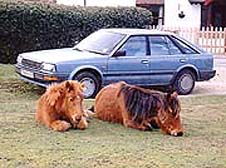
Wild horses were described in the area of the New Forest long before King William created his hunting lands. Persisting over the centuries, the current breed was much modified at the end of the nineteenth century. They still roam the sandy land with poor grass, heather and woodland. The ponies are of strong constitution and show little shyness to people and vehicles, the forest being well inhabited and criss-crossed by roads (see the picture at the top of the page). They are mainly brown or bay and tend to be gentle and surefooted.
There are some web-sites which feature New Forest Ponies The national, county and local Bridleroute network can now be viewed on-line, eg The Bishop Bennet Way 34 miles long in SW Cheshire, B&B for horses etc


