 A Horse Path
 A Horse Path
Hill Figures
Morris Marples (1949) noted 17 white horses and further numbers of hill figures and crosses in England. Almost all are associated with the chalk, but:
Roulston Scar, Yorkshire
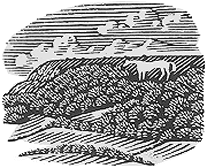
... in the Hambleton Hills (illustrated by Clifford Harper above left), on a slope of 40 degrees, facing south west it is visible from Thirsk 7 miles away, from the A1 and as far as York and Harrogate. Reputed to have been inspired by festivities at Uffington in September 1857, one Thomas Taylor returned to Kilburn in Yorkshire with an urge to create a white horse. More representational than Uffington, and facing left, it seems based upon other white horses. Apparently 33 men were paid by Mr Taylor to cut it in the slope, not of chalk (what is the geology?). The creature was limed and completed by November 4th the same year.
 This detail (left) from the Thirsk Parish Map shows the fondness that the local people still have for this figure (Click on the image to see more of the Thirsk map). Just for a day one Christmas the horse turned into a zebra. Nearby White Mare Crag has a legend, perhaps far older, about a young woman or jockey plunging over the cliff on their horse. How many high race courses on downs and hills hold to ancient ground for pitting horse against horse?
Osmington, Dorset.
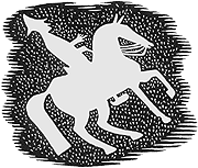
This horse with its rider, George III, was cut in 1815 perhaps to celebrate the monarch's visits to Weymouth. It must be at its best seen from the sea and one story has it that it was cut by engineers stationed there during fears of invasion by the French. Thomas Hardy in The Trumpet Major renders the horse as a memorial to the Battle of Trafalgar. Others suggest that it was one of many contemporary kinds of advertisement to show off royal patronage, maybe for something else entirely. This is the largest of the white horses 280 feet long by 323 feet high. Close up, the figure, massive as it is, loses its shape:After pacing from the horse's head down his breast to his hoof, back by way of the king's bridle arm, past the bridge of his nose and into his cocked hat, Anne said she had had enough of it and stepped out of the chalk clearing upon the grass. The Trumpet Major had remained all the time in a melancholy attitude within the rowel of His Majesty's right spur.
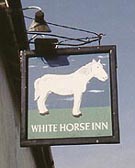
It is said that many public houses reflected the signs of the times shifting from being the Royal Oak of the Stuarts to the White Horse, emblem of the House of Hanover, when George 1st ascended the throne. The white horse of Osmington cleverly carried on the flattery. The sign at the top of this page can now be seen inside the eponymous pub in Stogumber, Somerset. And what of the Lost Horses of Devizes, Pewsey, Inkpen, Littlington and the Red Horse of Tysoe ... ?
References:
David Miles and Simon Palmer. Current Archaeology 142.
Thomas Hughes The Scouring of the White Horse (1857)
Morris Marples White Horses and other Hill Figures (orig. 1949; Alan Sutton 1981)
 Read about the STAYING POWER of the CERNE GIANT ...
... or about CHALK

