 A Horse Path
 A Horse Path
Horses and Ponies, alive and kicking ...
 Breeds of Horses
We are alone in the world in having so many indigenous horses in such a small space, the discrete habitats and the breeds have helped to create each other over long periods of time. Some are very ancient the Exmoor pony is thought to have been here since the Old Stone Age, the Dartmoor, the New Forest, the Dales and Fells ponies of the north Pennines have ancient roots. We also have the big working horses - the Cleveland Bay, the Suffolk Punch, the Shire, the Hackney for driving, and for racing and riding the English Thoroughbred. Over the centuries farmers and traders have selectively bred varieties of horses, cattle, sheep and pigs to make the best of local conditions and achieve the work of the area and time. Many of these, now rare, breeds do well on local herbage. The native ponies, in particular, are adapted to the fullest extremes of weather conditions, they thrive on poorer grasses, are strong for their size and sure footed in hilly and difficult terrain.
Exmoor Ponies
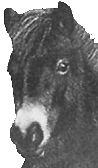
After the last glacial maximum dated around 21,000 years bp and with the rest of what is now England seized by tundra conditions, any re-establishment of plants and animals had to wait until the ice and permafrost receded. Sometime during the succeeding oscillations of climate, colonisation by trees and the disappearance of the land bridge linking us to mainland Europe (between 8-5,000 years ago), a group of animals made themselves at home on the open moors which are the source of the Exe. Isolated, the forbears of the Exmoor pony evolved and now persist as one of the world's most ancient breeds, somehow surviving man's predations and interferences. They are small, 11.2 13.1 hands high, with double thickness coats which keep out the cold and the wet. They are consistent in colour and marking shades of brown with darker points, with characteristic pale muzzle and eye surrounds. They are round, with extensive and efficient digestive systems carried on strong legs and feet that work well in wet and rocky conditions.
On the border of Devon and Somerset, this exposed area of wild high moorland facing the winds of the Atlantic which bring penetrating rain, snow and cold as well as hot sunny days. From the 11th century Exmoor was a Royal Forest a hunting ground - but with no woods at all within its bounds. Any management of the ponies tended to be based upon the principle that 'nature had the best design and introducing other blood led to dilution of hardiness'. But the expanse of the moor was sold in 1818 to an industrialist bent on productivity. He bred the ponies to the extent that they could no longer survive the harsh conditions. But the retiring Warden of the moor (Sir Thomas Acland) took thirty ponies and some of the surrounding farmers bought a few and we owe to them the continuance of the line. Many of the families are still breeding Exmoors and on Winsford Hill the descendants of Acland's herd are run, still carrying the Anchor brand mark.WWII also nearly saw their end indiscriminate target practice and rustling for meat left barely 50 animals. Mary Etherington inspired other Exmoor farmers and they began a careful programme of breeding. But the Rare Breeds Survival Trust still considers things very serious. Only a small number of animals remain, with few bloodlines, hence, although they are off the critical list, they are classed as endangered.Only about 200 feral ponies still graze Exmoor, their ancient and original habitat. Across the world as few as 1,200 exist.The Exmoor Pony Society oversees the gatherings that take place in October and November, when the year's youngsters are selected and branded, and an annual stallion parade is held in Exford in early May.Their continued presence on the moor is important, the place and the animal have evolved together for perhaps as long as there has been grass on Exmoor. They do not simply excite us as 'wild' creatures, they are, in some sense, the place itself. Full of stamina and strong, their lives were intertwined with those who made their living on the moor. They have been used for shepherding, driving, riding, agricultural tasks of all kinds and postal delivery.
But their future lies in finding new roles in situ and elsewhere and in addition to tourism, driving and riding they are earning their keep in other ways. Although it means small free living herds working in other places, one promising task performed with relish is that of conserving grassland habitat. They are very good at eating tough herbage tor grass, thistles, invasive scrub, grasses that crowd out delicate wild flowers. From Silverdale in Lancashire Margaret and Tim Mackintosh (Exmoor Ponies in Conservation) loan out their small herd of Exmoors for conservation grazing. At Gait Barrows they are helping to bring back the flowers on which the caterpillars of the Marsh Fritillary thrive.With the new millennium the Yorkshire Wildlife Trust put four Exmoors out onto Askham Bog on the edge of York to help its rehabilitation as the home of snipe, fibrous tussock sedge and the marsh carpet moth.In 2002 a herd of 30 Exmoors were brought on to the South Downs in Sussex to tackle grasses which other grazers will not touch, helping the conservationists to bring back the orchids and other grassland species characteristic of the chalk.There is a positive symmetry in one highly endangered creature building its own survival on the saving of others.
Visit some other Exmoor Pony web-sites
 Read about other distinctive breeds:
| Dales Pony | Heavy Horses: |
| Dartmoor Pony | Cleveland Bay |
| Fell Pony | Suffolk Punch |
| New Forest Pony | Shire Horses |
... or see them all


