 A Horse Path
A Horse Path
Uffington
White Horse (Grid Ref: SU 299864)
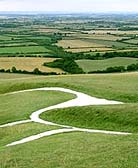
Whatever its age and purpose ...
... the White Horse is visible from long distances. This must have been important and while it now imparts meaning to a wide area it must have had more precise meaning to those who cut it. Was it a landmark, a territorial marker, totem or emblem, a celebration or monument? The proximity of Dragon Hill reinforces one legend that associates St George and the killing of the dragon with these parts. But Hughes in The Scouring of the White Horse (1857) weaves a question - what if it were Pendragon Hill the word implying chief of kings to the ancient Britons? (p23).
The first literary mention comes in the 12th century referring to ownership between 1072 1084 making it sound already old: Juxta locum qui vulgo Mons Albi Equi nuncupatur (Near the place which is commonly called White Horse Hill)
Even in the 14th century the Uffington White Horse was worth a detour, offered as a great monument second only to Stonehenge as recorded in Tractatus de Miribilibus Britanniae. Wise, in 1738, popularised the idea that origins lay with King Alfred, but Chesterton, in his Ballad of the White Horse, has Alfred endowing the horse with great antiquity whilst calling for its rescouring:
Before the gods that made the gods
Had seen their sunrise pass,
The White Horse of the White Horse Vale
Was cut out of the grass.
Chesterton notes that turf crawls as men sleep. Gravity and biology are constantly at work and sporadically people intervene. Over time there have been changes in both the shape and outline, and it is worth remembering the covering of hill figures in wartime since they would so clearly demonstrate to the enemy pilots where they were.
Thomas Hughes, author of Tom Brown's Schooldays, agreed to be chronicler to the White Horse in 1857 at the time of its rewhiting, and chose to write a fictional book The Scouring of the White Horse which is filled with real observation of the days of hard work and hard revelling - 17 and 18 September 1857. In the foreword, Hughes, resident in the parish, says: "But while we do not pretend to be antiquaries, or historians, or learned men, we do claim to be honest average Englishmen, and will yield to no man in our love for our own quiet corner of the land of our birth. .. we do hope that our example will lead Englishmen of other counties to cherish every legend and story which hangs around any nook of the neighbourhood, connecting it with the times and the men who have gone before; to let no old custom, which has a meaning, however rude, die out, if it can be kept alive; and not to keep either legend or custom to themselves."
Without moving at all the White Horse now finds itself in Oxfordshire, though it was in Berkshire in Hughes' day.
Archaeological evidence ...
... now suggests that the White Horse "belongs in the Bronze Age. Is this possible? If the local population could clean, scour and relay their icon for the past one thousand years, then why not longer? Certainly the Bronze Age was a period of remarkably varied and intensive activity around White Horse Hill" (David Miles and Simon Palmer, Current Archaeology 142). Their analyses for Oxford Archaeological Unit suggests the Uffington White Horse is an awesome 2890 3230 years old. This is the 1990s definitive estimation achieved out of archaeological work and Optical Stimulated Luminescence Dating (this method analyses the soil's last exposure to sunlight). They argue that the body of the beast has thinned no more than a metre from that time, though the angle has changed making it less visible from down hill.
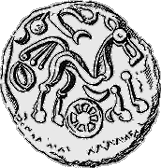
History rides with us, shapes us, depends upon us. The White Horse of Uffington is part of our 21st century surroundings and yet it has also belonged to those who preceded us for perhaps 3,000 years. Imagine the organisation it has taken intermittently for so many generations, all supposedly less wealthy, less civilised than ours, to tend the chalk so carefully to keep this creature, this icon, alive. Early Iron Age coins show representations of similar beasts, facing to the right.
Common Ground sell adhesive envelope re-use labels (left) featuring the Uffington White Horse in the design. Visit the publications list on www.commonground.org.uk for details of these and other available merchandise.
Wayland's Smithy (Grid Ref. SU 281854)
The shoeing of the White Horse is linked with Wayland's Smithy a chambered long barrow - only half a mile along the Icknield Way on the hill top. The story has persisted that on leaving a payment with your horse by the stones, the horse would have been mysteriously reshod on your return. Scandinavian myth gives Wayland Smith a white horse.This is an extraordinary place, said to be built upon an even older burial mound, the megalithic tomb (3700 3400 BC) is circled by trees and great stones form a deep entrance way.


